

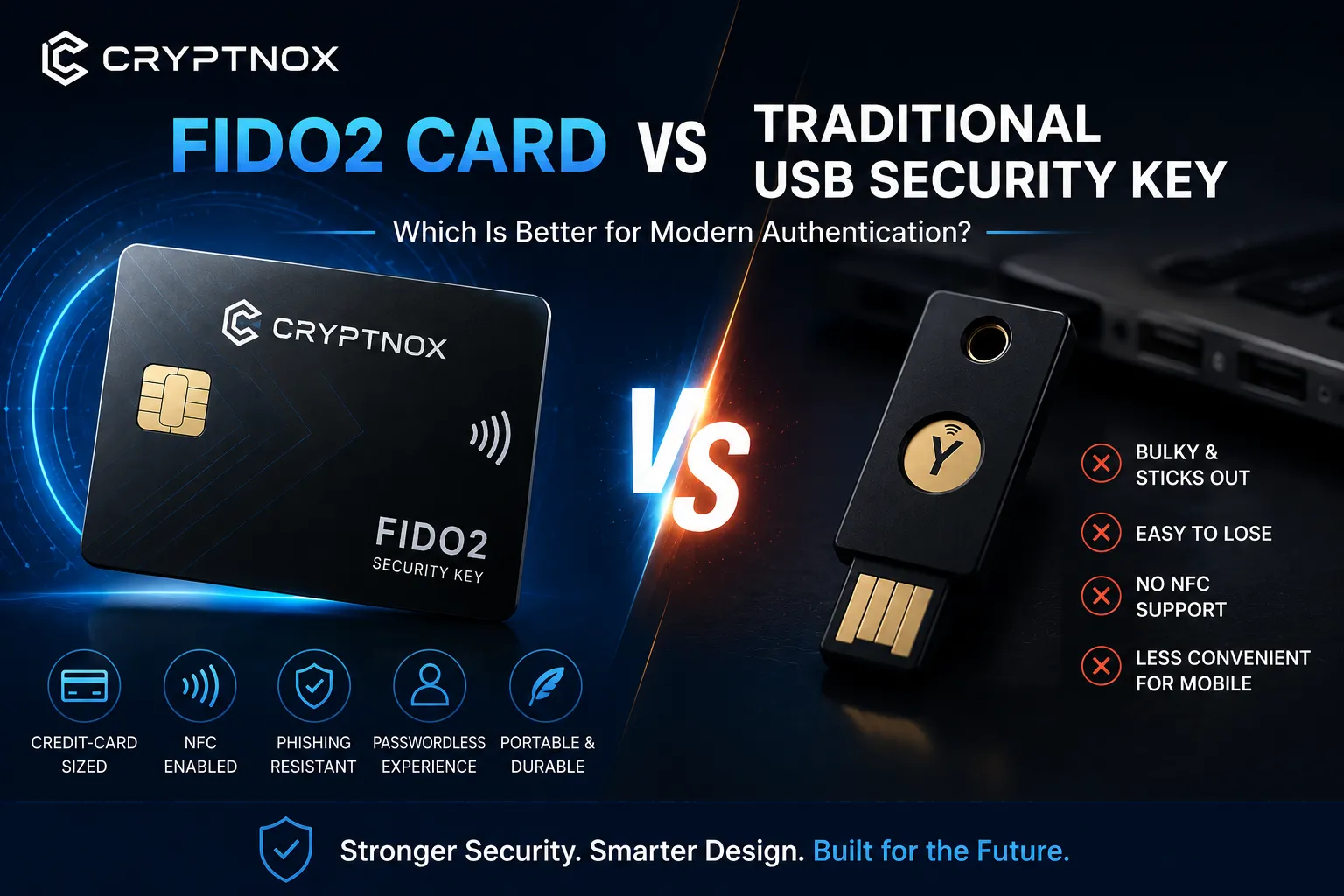
Cyberattacks targeting passwords continue to grow in both frequency and sophistication, making strong authentication more important than ever. Organizations are increasingly adopting FIDO2 authentication to reduce the risks associated with phishing, credential theft, and password reuse. While USB security keys have long been the standard for hardware-based authentication, a new generation of FIDO2 card solutions is changing how enterprises approach identity security. Combining smart card technology, NFC capabilities, and a credit-card-sized form factor, these devices offer a modern alternative for businesses seeking stronger security and better usability. This guide compares FIDO2 cards with traditional USB security keys, examining their strengths, limitations, and ideal use cases to help organizations choose the right authentication solution.
Understanding FIDO2 Authentication
FIDO2 is an open authentication standard developed by the FIDO Alliance and the World Wide Web Consortium (W3C). It enables passwordless and phishing-resistant authentication using public key cryptography rather than shared passwords.
Instead of transmitting secrets over the internet, a FIDO2 authenticator generates a unique cryptographic key pair for every registered service. The private key remains securely stored on the device, while the public key is shared with the application. This architecture significantly reduces the risk of phishing attacks, credential theft, and replay attacks.
Modern authentication solutions such as a FIDO2 card provide users with secure, convenient authentication across supported enterprise platforms and online services.
What Is a Traditional USB Security Key?
A traditional USB security key is a hardware authenticator that connects directly to a computer through a USB interface. These devices have become popular for multi-factor authentication (MFA) because they provide physical proof of identity during login.
USB security keys are widely supported across enterprise environments and cloud platforms. However, their reliance on USB ports can create limitations for modern mobile devices and organizations adopting flexible work environments.
While they remain effective for many use cases, changing workplace technology has increased demand for more versatile authentication methods.
What Is a FIDO2 Card?
A FIDO2 card combines passwordless authentication with smart card technology in a credit-card-sized format. Instead of functioning as a traditional USB token, many FIDO2 cards support NFC communication, allowing authentication through compatible smartphones, laptops, and other devices.
Solutions like the NFC security key offer a compact, durable design that easily fits into employee ID badge holders or wallets while providing strong cryptographic protection.
For organizations already using employee access cards or smart badges, integrating authentication into a card format can simplify daily workflows.
FIDO2 Card vs Traditional USB Security Key
Although both devices deliver phishing-resistant authentication, they differ in several important ways.
Form Factor
USB security keys are typically small dongles that attach to a keychain. While portable, they can be misplaced easily.
A FIDO2 card has the same dimensions as a payment or employee identification card, making it easier to carry in wallets, badge holders, or card sleeves.
Mobile Compatibility
As USB ports become less common on smartphones and lightweight laptops, NFC-enabled authentication is becoming increasingly valuable.
A security key card allows users to authenticate by simply tapping compatible devices, reducing the need for adapters or additional accessories.
Enterprise Deployment
Organizations deploying authentication across hundreds or thousands of employees often prioritize ease of distribution and user adoption.
Credit-card-sized authenticators can be issued alongside employee identification cards, reducing the number of separate devices users need to carry.
User Experience
A familiar card format often improves employee acceptance because it integrates naturally into existing workplace routines.
Instead of managing another USB device, employees can use one card for authentication and, depending on organizational implementation, additional identity-related functions.
Security Comparison
Both FIDO2 cards and traditional USB security keys rely on strong public key cryptography and hardware-based protection. Neither exposes private keys to connected systems, making them highly resistant to phishing and credential theft.
However, hardware design can influence usability and operational efficiency.
A FIDO2 card offers several advantages:
-
Credit-card-sized design for everyday portability.
-
NFC support for compatible mobile devices.
-
Easy integration with employee badges.
-
Strong hardware-based cryptographic protection.
-
Reduced dependence on USB ports.
USB security keys continue to provide excellent protection but may require adapters for newer devices that no longer include standard USB-A ports.
Which Solution Is Better for Enterprises?
The answer depends on deployment goals.
Traditional USB security keys remain an excellent option for environments centered on desktop computers with standard USB connectivity.
However, organizations embracing hybrid work, mobile authentication, and modern identity management increasingly benefit from FIDO2 card deployments.
A credit-card-sized security key offers practical advantages for enterprise rollouts by combining portability, strong security, and user familiarity in a single device.
Large organizations may also appreciate the ability to distribute authentication credentials using the same operational processes already established for employee ID cards.
Practical Use Cases
FIDO2 cards are particularly well suited for:
-
Enterprise employee authentication.
-
Government and public sector identity programs.
-
Higher education campus security.
-
Financial institutions.
-
Healthcare organizations.
-
Managed service providers.
-
Web3 and blockchain companies protecting administrative accounts.
USB security keys remain effective for individual users, developers, and organizations with primarily desktop-based authentication requirements.
Choosing the Right Authentication Method
When evaluating authentication hardware, organizations should consider:
-
Device compatibility across desktops and mobile platforms.
-
Ease of enterprise deployment.
-
Employee adoption and usability.
-
Long-term identity management strategy.
-
Integration with existing authentication infrastructure.
-
Support for phishing-resistant authentication standards.
The best solution is not simply the most secure device—it is the one employees will consistently use correctly while fitting seamlessly into organizational workflows.
Conclusion
Both FIDO2 cards and traditional USB security keys provide a substantial improvement over password-based authentication by protecting users against phishing, credential theft, and account compromise. While USB authenticators continue to serve many environments effectively, the FIDO2 card introduces greater flexibility through its credit-card-sized design, NFC compatibility, and enterprise-friendly deployment model. As organizations expand passwordless authentication initiatives and modernize identity management, FIDO2 cards represent a practical evolution that balances strong security with everyday usability. For businesses seeking a future-ready authentication solution that supports mobile workforces and enterprise-scale rollouts, adopting a FIDO2 card can be an important step toward building a more secure digital identity ecosystem.
