

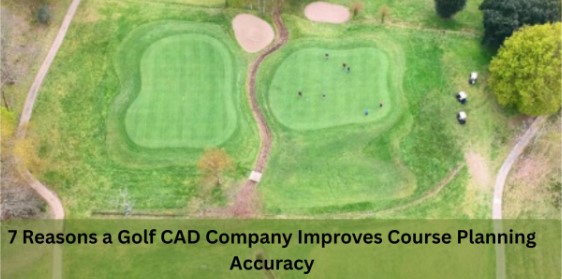
Accurate planning is the backbone of any successful golf course project. From routing fairways and shaping greens to managing drainage and earthworks, even small errors in planning lead to major construction challenges and long-term maintenance issues.
With the recent rise in the complexity of golf developments and increased sensitivity to budgets, the reliance on rough layouts or purely conceptual drawings is no longer sufficient. This is an area where a specialized golf CAD company becomes a must-have collaborator to bring precision, consistency, and technical clarity into the course planning process.
The following are seven key reasons why CAD-driven expertise significantly improves accuracy in golf course planning and reduces risk throughout development.
1. Accurate Translation of Design Intent into Quantifiable Data
Conceptual sketches and routing ideas are common first steps for many golf course designers, but they set the general direction rather than measurable detail.
CAD documentation methodically transforms creative intent into dimensionally accurate scaled drawings. Fairway widths, hole lengths, and green dimensions are conveyed numerically rather than estimated by eye. The accuracy conveyed means the planning decisions are built from real measurements rather than assumptions.
Accurate translation at this point prevents design drift as the project moves forward.
2. Accurate Representation of Terrain and Contour
One of the most critical-and most misunderstood- elements in golf course planning is terrain. Misjudging elevation changes can lead to grading errors, poor drainage, and exorbitant earthwork costs.
CAD tools allow planners to work directly with topographic survey data and ensure contours, slopes, and elevation transitions are correctly represented. Designers can assess how the course interacts with natural landforms in advance of any construction activity.
The accuracy of this level enables smarter land use and reduces unexpected site challenges.
3. Better Coordination Between Planning Disciplines
Golf course planning involves many disciplines: architecture, engineering, irrigation design, and environmental planning. Many conflicts between these teams are related to inaccurate or inconsistent documentation.
Technical basis through CAD-based planning helps the engineers, designers, and consultants to work on correct drawings, hence minimizing misalignment and duplication of efforts.
A golf CAD company maintains consistency of updates throughout all documents comprising the core planning workflow, such that accuracy is maintained while the design evolves.
4. Early Identification of Planning Conflicts
Many planning issues are apparent only when designs are reviewed in detail. Overlapping features, unrealistic slopes, or improperly aligned paths are difficult or impossible to detect in conceptual layouts.
These conflicts become visible in detailed CAD drawings. The following can be identified and resolved by designers:
Inconsistent grade transitions create:
- Conflicts between cart paths and play areas
- Drainage routes that interfere with gameplay
5. Increased Focus on Environmental and Regulatory Review
Modern golf projects are put under environmental scrutiny and regulatory approvals. Planning authorities need proper technical documentation to perform impact and compliance assessments.
CAD drawings clearly communicate:
- Land modification extents
- Water Management Strategies
Buffer zones – protected areas
Proper documentation lends credibility with regulators and reduces the likelihood of revisions or rejected submissions due to unclear planning information.
6. Iterative Planning Updates without Loss of Accuracy
Course planning seldom remains static. Feedback from stakeholders or site constraints and environmental considerations may require changes in layouts or grading.
The CAD-supported workflow enables fast revisions without compromising on accuracy. Changes ripple through drawings, and the planning documents always remain aligned.
This consistency prevents outdated or conflicting information from entering the later stages of development, a very common source of errors in planning.
7. Stronger Integration with Visualization and Presentation
Accurate planning not only ensures technical correctness but also has an effect on communicating the design. This is because CAD data often forms the basis for 3D visualization and presentations.
With correct CAD documentation, visualizations depict actual planning data instead of artistic interpretation. That is crucial at the point of collaboration with the best 3D rendering company to ensure that presentation visuals match what can actually be built.
This alignment strengthens stakeholder confidence and avoids misunderstandings between approved visuals and constructed results.
Why Long-term Planning Accuracy Matters
Planning errors don’t disappear once construction begins; they compound. Inaccurate layouts lead to a number of issues:
- Cost overruns from regrading or redesign
- Compromised Playability and Safety
- Higher long-term maintenance costs
Accurate planning reduces those risks since decisions from the beginning are based on technical reality.
Supporting Smarter Cost Control
Precise planning has a direct impact on budget control. Earthwork quantities, material estimates, and construction sequencing depend upon accurate planning data.
CAD-driven accuracy enables developers to:
- Forecast costs more reliably.
- Avoid excessive rework.
- Make informed trade-offs while planning.
This financial predictability is most helpful for large-scale or phased golf developments.
Building Confidence Among Stakeholders
It is important that investors, developers, and planners be certain the project is viable or well considered. Accurate CAD documentation reflects professionalism and attention to detail.
Clearer, more specific plans breed trust among stakeholders. Meetings revolve less around clarification and more around refinement; approvals go through more easily.
Confidence garnered during planning carries across the entire project life-cycle.
Why Specialized CAD Expertise Makes the Difference
General drafting services seldom understand the specific planning requirements of golf courses. Golf courses have unique considerations-shot distances, safety zones, slope tolerances, and maintenance access-that require specialized knowledge.
A CAD team experienced in golf projects intuitively knows these nuances and applies them consistently. The result is planning documents that truly support course design, not just illustrate it.
Planning Accuracy as Risk Management
Every bad drawing carries risk. Every unclear detail leaves room for error. Planning through precision is risk management in its own right. It limits uncertainty and safeguards schedules and budgets. The earlier the accuracy is established, the greater its impact on project success.
Conclusion
Accurate course planning is the very foundation of successful golf development, and precision cannot be left to chance. A professional golf CAD company increases planning accuracy at each stage by translating design intent into measurable data, improving coordination, and underpinning informed decision-making.
